2025-06-24_TNB-s-New-Electricity-Tariff—Malaysia-8272fc24adf6
Decoding Your Bill and What it Means for Your Future
TNB’s New Electricity Tariff — Malaysia
Decoding Your Bill and What it Means for Your Future
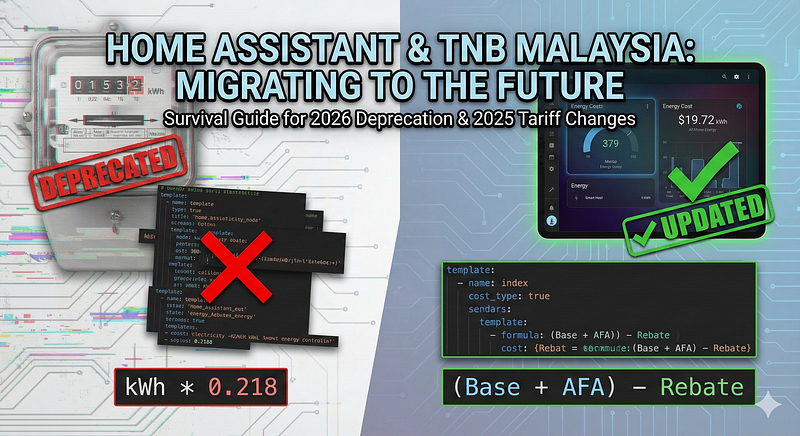
Created by Author via Gemini
This is AI assisted writing when I research for this topic
Intro
Starting July 1, 2025, over 23.6 million domestic electricity consumers in Peninsular Malaysia will see a significant shift in how their TNB bills are calculated. This isn’t just a minor tweak; it’s a fundamental restructuring of the electricity tariff, designed to usher in a new era of energy management and reflect the evolving landscape of power generation and delivery.
While sample bills might show immediate savings for some, a closer look reveals that this change is about much more than just a lower number at the bottom of your statement. It’s a strategic move by TNB and the Energy Commission to prepare for a future driven by fluctuating global markets, a push for renewable energy, and the inevitable rise of prosumers with solar rooftops.
Unpacking the New Bill: More Than Just kWh
Gone are the familiar tiered rates for domestic consumption. The new bill calculation formula for domestic customers is more transparent, breaking down the cost into several components:
Total Bill = (Total kWh x Energy) + (Total kWh x AFA) + (Total kWh x Capacity) + (Total kWh x Network) + Retail Charge — EE Incentive + Other Charges
Let’s dissect what each component means:
- Energy (Generation Charge): This is the core cost of the electricity you consume, measured in kilowatt-hours (kWh). Unlike the old tiered system, this is now largely a two-tier structure: one rate for usage up to 1,500 kWh/month, and a higher rate for usage above that.
- AFA (Automatic Fuel Adjustment): This is perhaps the most significant and volatile change. Replacing the semi-annual Imbalance Cost Pass-Through (ICPT), AFA will now adjust monthly based on global fuel prices (primarily coal and natural gas) and foreign exchange rates. This is a direct pass-through mechanism, meaning if fuel prices rise, so will your AFA, acting as a surcharge. Conversely, if they fall, it will be a rebate.
- Capacity Charge: This is a fixed rate per kWh that covers the cost of ensuring a reliable electricity supply, including maintaining power plants and standby capacity. Think of it as paying for the availability of power, even when you’re not using it.
- Network Charge: Also a fixed rate per kWh, this component covers the cost of operating and maintaining the vast grid infrastructure — the transmission lines, distribution networks, and substations that deliver electricity to your doorstep.
- Retail Charge: A fixed monthly charge for customer services, metering, and billing. Notably, this charge is waived for domestic households consuming 600 kWh or less per month.
- EE Incentive (Energy Efficiency Incentive): This is a new rebate introduced to encourage prudent electricity use. Domestic consumers with consumption of 1,000 kWh and below per month are eligible for this incentive, with the rebate amount decreasing as consumption rises within that band.
Beyond the Savings: What Future is TNB Preparing For?
The unbundling of these charges and the introduction of a monthly AFA are not arbitrary. They reflect TNB’s strategic preparations for a dynamic and potentially challenging future:
- Responding to Fuel Price Volatility: The immediate and obvious reason for the monthly AFA is to better manage the inherent volatility of global fuel prices. Events like geopolitical instability or disruptions in supply chains can cause dramatic swings in commodity markets. By adjusting monthly, TNB aims to avoid absorbing large losses (or accumulating large surpluses) and can pass these costs (or savings) to consumers more gradually, preventing the shock of large, infrequent tariff hikes. While not directly “preparing for war,” it certainly builds resilience against market disruptions that can arise from global conflicts.
- The National Energy Transition Roadmap (NETR): This new tariff structure is a cornerstone of Malaysia’s ambitious NETR, aiming for a more sustainable and green energy future.
- Encouraging Energy Efficiency: The Energy Efficiency Incentive and the expanded Time-of-Use (ToU) options (more on this below) are direct tools to nudge consumers towards more mindful energy consumption, reducing overall demand and optimizing grid load.
- Investing in Grid Modernization: The distinct Capacity and Network charges underscore the substantial investments TNB is making in upgrading its grid. A modernized, smarter grid is crucial for handling the integration of more renewable energy sources like rooftop solar.
- The Rise of Solar Rooftops (Prosumers) and “Cost to Serve”: As more homes install solar panels, they become “prosumers” — both consuming from and producing for the grid. While excellent for decarbonization, this presents a unique challenge for utility companies. Even when solar customers are generating their own power, they still rely on the grid for:
- Backup Power: During the night or on cloudy days.
- Grid Stability: The grid provides stable voltage and frequency.
- Net Metering: The ability to export excess power. The Capacity and Network charges ensure that these fixed costs of maintaining a reliable and robust grid are still shared, even by those who consume less energy from it. This prevents a scenario where non-solar users disproportionately bear the burden of grid upkeep. Future tariff adjustments may even see more specific grid access charges for prosumers, a trend seen in other mature solar markets.
Domestic Tariff A: The Opt-In Decision and Why Staying Put Might Be Smart
Crucially, while the new domestic tariff calculation formula applies to all 23.6 million households, the Time-of-Use (ToU) tariff is an opt-in service for domestic customers with smart meters (or CT/RMR meters). You are not automatically migrated to ToU.
TNB has provided sample bills suggesting potential savings, especially for consumers below 900 kWh/month. This is primarily due to the Energy Efficiency Incentive and the waiver of the Retail Charge for lower consumption.
However, even if the sample bills today look appealing for opting into the ToU tariff, a cautious approach is warranted:
- Volatile AFA: Remember the AFA component. While the base energy rates might seem lower now, a significant hike in global fuel prices could lead to higher monthly surcharges, quickly eroding any perceived savings. Sample bills often assume a neutral AFA or a small rebate.
- ToU’s Double-Edged Sword: The ToU tariff offers cheaper off-peak rates (generously defined as 10 PM to 2 PM weekdays, and all day weekends) but higher peak rates (2 PM to 10 PM weekdays).
- Evaluate Your Habits: If you can genuinely shift a large portion of your high-consumption activities (e.g., charging EVs, running washing machines, using air conditioning extensively) to off-peak hours, ToU could be beneficial.
- The Risk: However, if your lifestyle or business operations necessitate significant power usage during peak hours, opting into ToU could lead to a higher overall bill compared to staying on the standard (now unbundled) domestic tariff.
- “Savings” Now vs. Future Reality: The “savings” shown in initial bill examples are based on current assumptions. The AFA’s monthly fluctuations introduce an unpredictable element. For many households, especially those whose consumption patterns are difficult to change, sticking with the default, unbundled domestic tariff (which still benefits from the EE Incentive and Retail Charge waiver for lower usage) might be the safer bet. This allows you to experience the new transparent billing while avoiding the higher peak rates of ToU.
In conclusion, TNB’s new tariff structure marks a significant step towards a more transparent, responsive, and sustainable energy ecosystem in Malaysia. While touted for its initial savings for many, particularly lower spending consumers, the shift also lays the groundwork for adapting to future energy realities. For domestic consumers, understanding each component of the new bill and carefully evaluating personal consumption habits before opting into the ToU tariff will be key to truly benefiting from these changes.